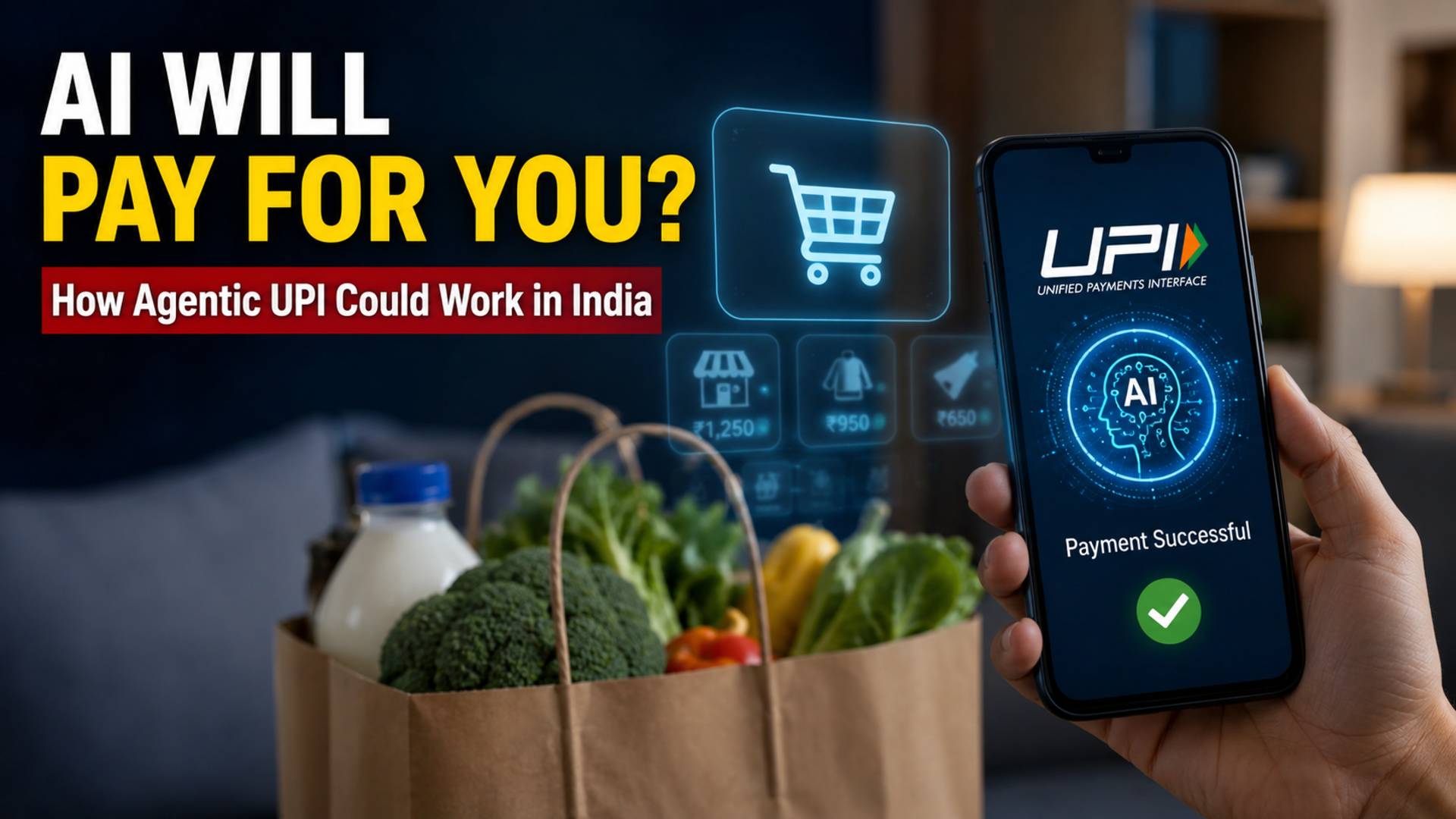
Imagine telling an AI assistant, “Buy my usual groceries for up to ₹1,500,” and the AI finds the products, compares prices, places the order and completes the UPI payment without asking you to approve every transaction.
That is the basic idea behind UPI agentic payments.
India is now working toward an infrastructure that could allow AI agents to make payments on behalf of users under predefined rules and controls. Reports indicate that the National Payments Corporation of India (NPCI) is developing a proposed Unified Agent Protocol (UAP) for this purpose. The reported approach would build on UPI rather than replace it.
It is essential that one differentiates between those things that have been implemented and those that are under development.
What Are UPI Agentic Payments?
UPI agentic payments refer to a payment model in which an AI agent can take an action and initiate a payment on a user’s behalf, rather than simply telling the user how to pay.
A normal UPI transaction generally requires a person to initiate and authenticate the payment.In this case, the AI-based agent would be capable of interpreting the user’s command, selecting a suitable transaction and performing it within the boundaries set earlier by the user.
For instance, a user may ask the AI agent to:
“Order my regular grocery every Sunday, but don’t exceed ₹2,000.”
The agent could potentially:
- Understand the instruction.
- Search available products or services.
- Option selection based on preference of the user.
- Confirm that the amount being paid is within the permissible range.
- Initiate the UPI transaction.
- Record and report the transaction to the user.
The important difference is delegated decision-making. The AI is not merely displaying a UPI payment screen; it is potentially acting as an authorized payment agent.
How Will AI Payments Work on UPI?
The exact final architecture of India’s proposed agentic-payment framework has not yet been publicly established in full. Reports about the proposed UAP indicate that the system is expected to introduce mechanisms for agent identity, spending rules, transaction limits and accountability.
A simplified model could look like this:
User → AI Agent → Rules & Authentication → UPI → Merchant
Suppose you authorize an AI agent to spend up to ₹5,000 on household purchases.
The agent would first need to operate within the permissions you have provided. If the transaction satisfies those conditions, the payment infrastructure could authorize the transaction without requiring you to manually approve every individual payment.
This is fundamentally different from giving an AI unrestricted access to a bank account. The objective is expected to be controlled autonomy, not unlimited autonomy.
UPI Agentic Payments vs Normal UPI
| Feature | Normal UPI | Agentic UPI |
| Main actor | Human user | AI agent acting for user |
| Payment decision | Usually made by user | Can be made by AI within rules |
| Authentication | User-driven | Potentially delegated/controlled |
| Spending rules | Existing UPI limits and mandates | User-defined agent permissions may apply |
| Automation | Limited | Designed for autonomous actions |
| Best use case | Everyday payments | Automated purchases and services |
The exact limits and authentication mechanisms for a future UAP-based system should not be assumed until NPCI and regulators formally publish the final rules.
What Technologies Already Make This Possible?
Agentic payments are not emerging from nothing. UPI already has features that demonstrate how controlled delegation and pre-authorisation can work.
UPI Circle
NPCI introduced UPI Circle to allow a primary user to delegate payment responsibilities to trusted secondary users.
Under the full-delegation framework, a primary user can authorize another person to make payments from the primary user’s account within predefined limits. NPCI’s 2024 framework specified limits for full delegation, while BHIM later implemented full delegation with a monthly spending limit of up to ₹15,000.
NPCI also expanded UPI Circle to certain IoT devices and software profiles, including AI profiles in a limited closed-user-group context. Importantly, the October 2025 circular stated that debit transactions through IoT devices were to be initiated by explicit user action.
This is relevant because it demonstrates the broader concept of delegating payment authority to something other than the primary user directly operating the payment app.
UPI Reserve Pay
Another important building block is UPI Reserve Pay, previously known as UPI Single Block and Multiple Debits.
It allows funds to be blocked upfront and then used for multiple eligible debits until the reserved amount is exhausted, revoked or expires. NPCI’s subsequent guidelines expanded its applicability to permitted UPI funding sources.
This type of pre-authorized payment mechanism could be useful for agentic commerce because an AI system needs clearly defined boundaries around how much it can spend.
What Could AI Agents Buy Through UPI?
The most practical early applications are likely to involve routine, relatively low-value transactions.
Potential examples include:
Grocery purchases
An AI could monitor a user’s regular shopping requirements and purchase items according to predefined preferences and spending limits.
Bill payments and recurring expenses
An agent could potentially identify upcoming payments and execute authorized transactions according to user-defined rules.
Travel bookings
An AI could compare flights or hotels based on price, timing and preferences, then potentially complete the purchase when the transaction meets the user’s conditions.
E-commerce
Instead of searching several websites manually, a user could give an AI a budget and requirements and allow it to complete an eligible purchase.
Business expenses
Companies could potentially use AI agents for repetitive operational purchases, subject to stronger authorization, accounting and spending controls.
These are potential use cases, not a guarantee that every application will be permitted under the final Indian framework.
Why Does India Need Agentic Payments?
AI agents are becoming increasingly capable of moving from answering questions to performing actions. But payment is a major barrier. An AI can search for a product, compare prices and select an option. The process traditionally stops when a human must authenticate and complete the payment.
Agentic payments attempt to connect AI decision-making with payment infrastructure. That could reduce friction in situations where a transaction is routine and already authorized.
The scale of India’s UPI ecosystem makes this particularly significant. UPI processed a record 24.51 billion transactions worth ₹29.82 trillion in August 2026, according to NPCI data reported on September 1.
The opportunity is therefore not simply about making UPI faster. It is about potentially making digital commerce more autonomous.
Is Agentic UPI Safe?
This is one of the biggest questions. Giving an AI the ability to spend money creates risks that do not exist to the same degree when a human manually approves every transaction.
Possible risks include:
- AI misunderstanding a user’s instruction
- Fraudulent merchants or manipulated payment requests
- Unauthorized agent access
- Excessive spending
- Incorrect purchases
- Disputes over whether an AI acted within its authority
- Difficulty determining responsibility when something goes wrong
That is why agentic payments require strong controls around identity, authorization, transaction limits, monitoring and liability.
Reports about NPCI’s proposed UAP specifically point to mechanisms such as spending limits, rule-based payments, identity verification and liability provisions. The central principle should be simple: the user should control what the AI is allowed to do.
Is UPI Agentic Payments Available in India Now?
Not as a fully launched, nationwide UPI feature under the proposed Unified Agent Protocol. NPCI is developing the framework, while payment companies have already been experimenting with agentic commerce and AI-enabled payment experiences.
For example, Razorpay has announced agentic-payment initiatives involving UPI, including payment experiences designed around AI-native commerce. Pine Labs has also announced its own agentic payment protocol and described production deployment of an AI-agent payment capability. These initiatives should not be confused with a final nationwide UAP rollout by NPCI.
There is also an important distinction between conversational payments and agentic payments. NPCI’s Hello! UPI already enables users to interact with UPI through voice and conversational interfaces, but the existing product still operates within established UPI authentication and controls. Agentic payments go a step further by allowing software to potentially act on the user’s behalf.
What Could Change for UPI Users?
If the proposed system is implemented successfully, the biggest change may be a shift from “click to pay” to “authorize and let the agent act.”
Instead of repeatedly approving routine purchases, users could define:
- What the AI can purchase
- How much it can spend
- Which merchants or categories it can use
- When it can make payments
- When human approval is required
For users, this could make routine digital commerce significantly more convenient.
For banks, fintech companies and merchants, however, it creates a new challenge: they must determine how to authenticate, monitor and assign responsibility when the “person” initiating a transaction is actually an AI agent.
The Bottom Line
UPI agentic payments could represent the next major evolution of digital payments in India.
UPI already provides the payment infrastructure, while features such as UPI Circle and UPI Reserve Pay demonstrate how delegated authority and pre-authorized funds can work within controlled limits. AI agents could eventually use similar concepts to execute transactions based on instructions given by users.
But the technology is still evolving. The proposed Unified Agent Protocol should therefore be viewed as an emerging framework rather than a fully established UPI feature. Its long-term success will depend not only on how intelligently AI agents can make decisions, but also on how effectively India can control authorization, spending limits, fraud, privacy, disputes and liability.
The real breakthrough will not be simply teaching AI how to pay. It will be creating a system where AI can pay but the human is still firmly in charge.
Learn More : Gold Loans in India
FAQs
What are UPI agentic payments?
UPI agentic payments are a proposed model in which AI agents can initiate UPI payments on behalf of users within predefined permissions, rules and spending limits.
What is the Unified Agent Protocol?
The Unified Agent Protocol, or UAP, is a proposed framework reportedly being developed by NPCI to enable trusted AI agents to interact with UPI payment infrastructure. It is not the same thing as replacing UPI.
Can AI make UPI payments without a PIN?
The future framework is expected to reduce the need for a human to authenticate every individual transaction, but the exact authentication and authorization mechanism will depend on the final rules. Existing UPI requirements should not be assumed to have been removed.
Is agentic UPI available to everyone in India?
No. The proposed nationwide NPCI framework is still under development. Some companies are already testing or deploying agentic payment technologies, but these should not be confused with a finalized nationwide UAP rollout.
Is UPI Circle the same as agentic payments?
No. UPI Circle allows users to delegate payment authority to trusted secondary users and, in certain implementations, supports delegated payment arrangements. Agentic payments involve software or AI agents acting on a user’s behalf.
Will AI be able to buy anything using UPI?
Not necessarily. Agentic payment systems are expected to operate within authorization rules, spending limits and other controls. Early use cases are expected to focus on controlled, routine transactions.
What are the biggest risks of AI payments?
Major problems include unapproved transactions, fraudulent activities, AI decision-making errors, overspending, privacy issues, and problems related to assigning responsibility for the transaction made by the AI agent.
Will agentic payments replace UPI?
No. The proposed approach is intended to operate on or alongside existing UPI infrastructure rather than replace UPI itself.
Join us on YouTube : Inside Business