
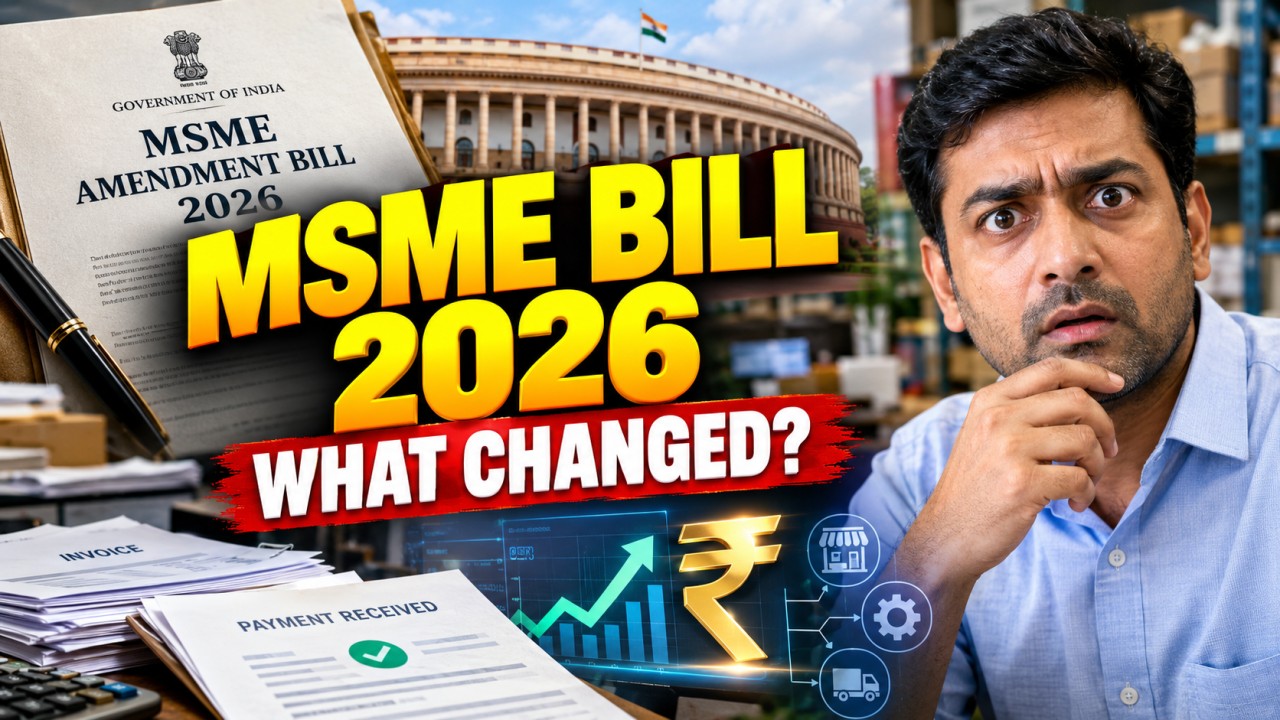
The sector of MSMEs in India is receiving a new regulation regime. The MSME Amendment Bill 2026 was tabled in the Rajya Sabha on 28th July, 2026 and received clearance in the Rajya Sabha on 3rd August. It received clearance from the Lok Sabha after four days, that is, on 7th August. The assent of the President was provided on 13th August, 2026 thus making the Bill into the Micro, Small and Medium Enterprises Development (Amendment) Act, 2026 (Act No. 16 of 2026).
The reform for small businesses goes beyond mere procedural issues. The amendment deals with some of the problems MSMEs face in their day-to-day business, particularly when customers delay payments. It also brings changes to the way enterprises are classified and registered, gives a bigger role to digital systems such as Udyam and TReDS, and changes how payment disputes are handled.
One point is important, though. Becoming an Act does not mean every provision starts applying immediately. The government still has to notify the dates on which the different provisions will come into effect. So, businesses should look at the relevant notifications before changing their existing compliance or payment practices. However, an important distinction remains: the Act itself says its provisions will come into force on dates notified by the Central Government, and different provisions can have different commencement dates.
What Is the MSME Amendment Bill 2026?
The MSME Amendment Bill, 2026 is an amendment bill to the Micro, Small and Medium Enterprises Development Act, 2006 which is the core piece of legislation that governs the MSME segment of India.
The justification behind the need to amend this legislation have been stated by the Government to be the need to bring about changes in the legislation as per the changing MSME environment.
However, the significance of the above changes has become more relevant with the growth of the formal MSME ecosystem. As reported by the government, about 9.16 crore MSMEs have been registered on the Udyam portal till August 2026. They generate jobs for more than 40 crore individuals. According to the economic survey 2025-26, the contribution of MSMEs to the GDP is 31.1%, manufacturing value-added is 35.4%.
Key Changes Under the MSME Amendment Act 2026
1. MSME Classification Gets a New Framework
The amendment uses a dual criterion method for classification of MSMEs as regards investment in plant, machinery, or equipment and turnover. This is an improvement on the previous format where only investment criteria were provided.
This is due to the adaptability of the framework to changes as companies grow. The detailed limits and implementation requirements can be prescribed through the relevant government framework.
2. Udyam Registration Becomes a Permanent Digital Framework
The amendment provides statutory backing for the Udyam Registration Portal as a digital, free and voluntary registration platform for MSMEs.
The government can also provide for national and state digital platforms, while states may use registration information for extending applicable scheme benefits.
This is important for businesses because formal registration can help establish an enterprise’s identity within the government-supported MSME ecosystem.
The amendment also works alongside the existing Udyam Assist framework, which helps bring eligible informal micro enterprises into formal recognition.
3. TReDS Gets a Bigger Role in MSME Payments
One of the most significant changes concerns the Trade Receivables Discounting System (TReDS).
Under the amended framework, Central Public Sector Enterprises (CPSEs) are required to route settlement of invoices relating to procurement of goods and services from MSMEs through a TReDS platform. States are also given enabling provisions to require their public-sector entities and other notified bodies to use TReDS.
TReDS is an electronic system that helps MSMEs finance or discount trade receivables through participating financiers.
The scale of the platform has already grown substantially.The government has revealed that the volume of invoice discounting using TReDs has gone up from around ₹40,000 crore in 2022-23 to ₹3.47 lakh crore in 2025-26.
The development can help MSMEs selling goods to the eligible public sector enterprises get more liquidity and not depend on getting their bills cleared.
Faster MSME Delayed-Payment Dispute Resolution
Late payments have been a long-time issue in terms of working capital among small firms. This modification is to improve the mechanism of dispute resolution that is carried out by the MSEFCs.
The new timelines include:
| Stage | Timeline |
| Completion of mediation | 90 days from first appearance |
| Referral to arbitration after mediation ends | Within 30 days |
| Arbitral award | 90 days from completion of pleadings |
These timelines are designed to reduce prolonged disputes and give MSME suppliers a clearer path toward recovery.
The amendment also enables the Central Government to establish online mechanisms for mediation and arbitration, potentially making dispute resolution more accessible without requiring every stage to be handled physically.
Stronger Recovery of MSME Dues
The amendment addresses another important problem: winning a dispute does not automatically mean receiving the money quickly.
Under the amended framework, a mediated settlement agreement or arbitral award under Section 18 can be recovered as an arrear of land revenue through the District Collector, Deputy Commissioner or another notified authority having jurisdiction over the buyer’s assets.
This strengthens the enforcement mechanism available to eligible micro and small enterprise suppliers.
The amendment also retains the 75% pre-deposit requirement for a non-supplier seeking to challenge an award or mediated settlement agreement. Where the challenge remains pending for more than six months, the court must order payment of at least 50% of the awarded amount to the MSE supplier from the deposited amount.
More MSE Facilitation Councils
The amendment allows states greater flexibility to establish multiple MSEFCs.
The objective is to improve institutional capacity and reduce delays in payment disputes. The government has said that multiple councils, supported by appropriate physical infrastructure, digital systems and trained personnel, can help speed up disposal of cases.
As of August 2026, the government reported 161 MSEFCs across states and Union Territories.
Decriminalisation and Graded Penalties
Another important change is the move away from certain conviction-based penalties toward a more graded compliance framework.
For specified violations, the amended law introduces warnings for first instances and monetary penalties for subsequent violations. Non-disclosure of unpaid MSME dues by buyers also moves toward a graduated system involving a warning, penalty and, for later violations, a fine.The aim here would be that of having a more proportional and trust-based approach towards regulation, without compromising on the punishment of non-conformity.
What Does the MSME Amendment Act 2026 Mean for Businesses?
For MSME owners, the most important potential benefits are likely to come from better payment mechanisms, faster dispute resolution and easier digital registration.
A small supplier dealing with a covered public-sector buyer could potentially benefit from TReDS-based invoice settlement. An MSE facing a payment dispute could have clearer statutory timelines for mediation and arbitration. Stronger recovery provisions could also improve the practical value of obtaining a favourable settlement or award.
However, businesses should not assume that every new provision is already operational simply because the Bill has become an Act. The commencement clause allows the Central Government to notify when the provisions take effect, including different dates for different provisions.
Therefore, businesses should check the relevant commencement notifications and subsequent rules before changing compliance procedures, contracts or payment processes.
Common Misconceptions About the MSME Amendment Bill 2026
The Bill is still just that – a proposal.
No. It was enacted by Parliament in August 2026, and received Presidential assent on August 13, thus becoming the MSMED (Amendment) Act, 2026.
All new provisions automatically became effective on August 13.
Not necessarily. The Act provides that its provisions will come into force on dates appointed by Central Government notification, with different dates possible for different provisions.
The amendment only deals with delayed payments.
No. It also changes classification, registration, TReDS usage, MSEFC functioning, dispute resolution and penalties.
Related Articles : Profitable Wholesale Business Ideas
FAQs
What is the MSME Amendment Bill 2026?
MSME Amendment Bill 2026 is an amendment to the MSMED Act 2006, which establishes the legal regime for MSMEs in India. This amendment is made in various areas such as MSME registration, classification, delayed payments, and the method adopted for solving disputes regarding delayed payments. Digital methods have been provided more importance in the MSME regime.
When was the MSME Amendment Bill 2026 passed?
This bill was passed by the Rajya Sabha on 3rd August, 2026 and by the Lok Sabha on 7th August, 2026. The bill got Presidential assent on 13th August, 2026 and thus became the Micro, Small and Medium Enterprises Development (Amendment) Act, 2026.
What is the biggest change for MSMEs?
One of the major shifts that have occurred includes the improved delayed payment system, such as TReDS invoice payments for CPSE procurements, resolution timelines and recovery processes.
What is TReDS in the MSME Amendment Act 2026?
TReDS is an electronic platform for financing or discounting MSME trade receivables. The amendment requires CPSEs to route settlement of covered MSME procurement invoices through TReDS.
Is Udyam registration compulsory under the amendment?
The government describes the amended framework as providing a free and voluntary digital registration platform for MSMEs.
How long can MSME mediation take under the amended framework?
The amended framework provides for completion of mediation within 90 days from the date fixed for first appearance. In case mediation fails, the MSEFC is required to refer the dispute to arbitration within thirty days.
Has the MSME Amendment Act 2026 come into force?
The Act became law after receiving the President’s assent on August 13, 2026. However, this does not imply that all of these provisions were made applicable from the very same date. It is left to the Central Government of India to notify the date on which the provisions become applicable. Therefore, MSMEs and buyers must wait until such notifications have been made before assuming that the change is applicable.
Conclusion
The MSME Amendment Bill, 2026 has been converted into MSMED (Amendment) Act, 2026. It is a huge leap towards making the legislation for MSME more modernized. Its most important themes are faster payments, stronger recovery, digital systems, time-bound dispute resolution and more proportionate compliance.
For MSME owners, the practical significance will depend not only on the legislation itself but also on the commencement notifications, rules and implementation mechanisms that follow. The best approach is to understand the new framework now while verifying the effective dates before making compliance or contractual changes.
Join us on Telegram Group.
Related posts:
 ఎలాంటి పెట్టుబడి లేకుండా వ్యాపారం ప్రారంభించడం ఎలా ? (How to Start a Business with Zero Investment)
 Understanding Basic Business Terms: A Glossary for Beginners
 Ratan Tata Biography | Success Story of Entrepreneurs
 Satya Nadella Quotes to Unlock Your Potential
 Elon Musk Net Worth in Rupees: Business Secrets