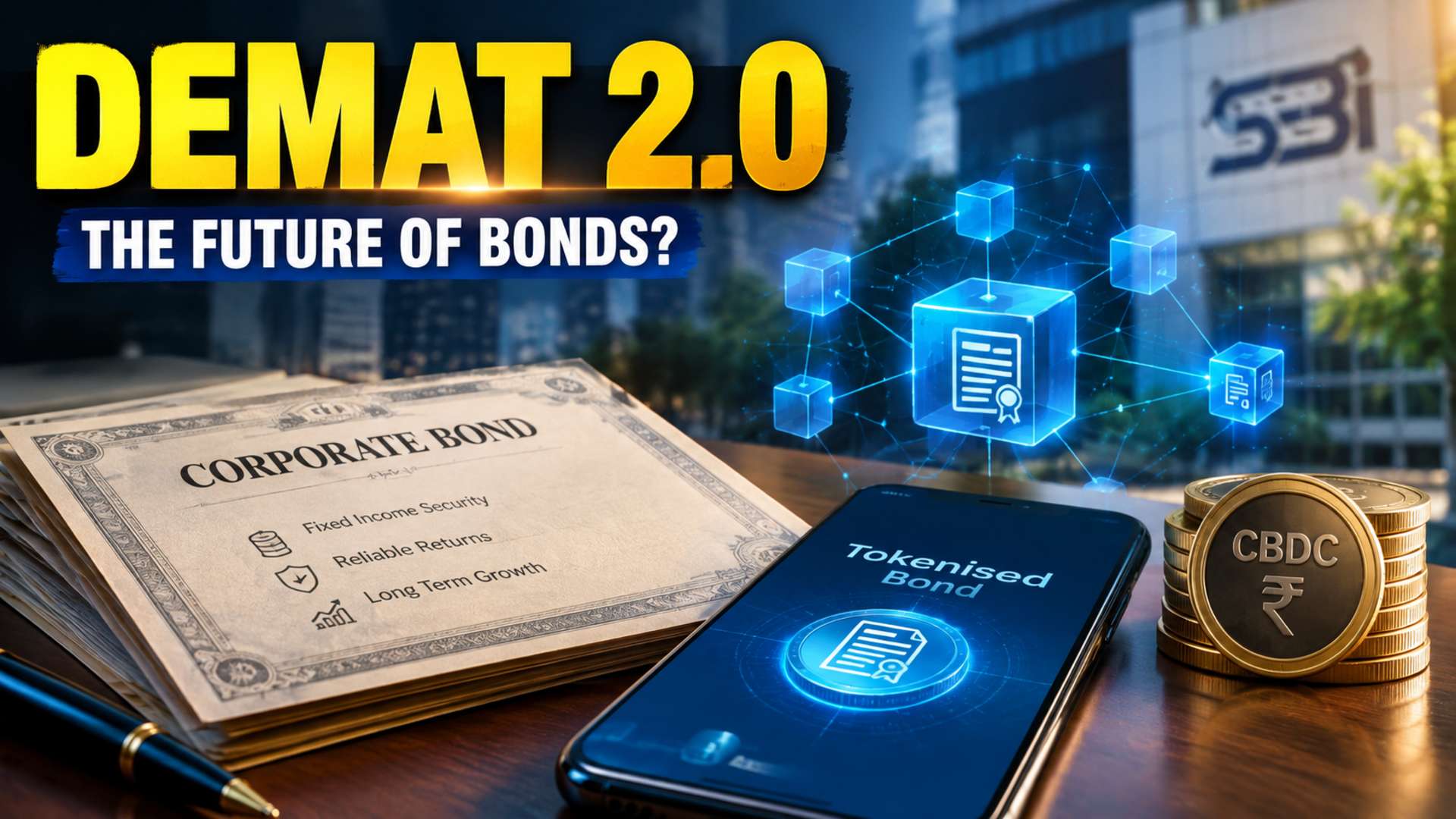
Imagine buying a corporate bond in the future and, behind the scenes, the bond and your payment are transferred almost simultaneously through a digital system. You still own a bond. You still receive interest. You still have a maturity date and the same basic rights attached to the security.
But the technology recording and settling that investment is very different. That is the idea behind Demat 2.0. While the title may seem like your usual demat account taken to another level, it is more than that. SEBI is trying out a system where corporate bonds will be issued in the form of tokens using DLT while the payment side of things could be in the form of CBDC from the Reserve Bank of India.
While this is what tokenised bonds means, if you’re confused about whether or not India has its own crypto investment, the answer would be no. The investment is still a regulated corporate bond. The big change is the technology used behind it.
What exactly is Demat 2.0?
In essence, Demat 2.0 refers to a SEBI experiment intended to explore a novel approach towards issuance, holding, transfer and settlement of corporate bonds. Securities today are already stored electronically in demat accounts.
Demat 2.0 takes the concept further by experimenting with native digital tokens representing corporate bonds on a permissioned distributed ledger. That doesn’t turn the bond into a cryptocurrency.
The underlying security retains its own inherent features such as ISIN, coupon rate, maturity, covenants, ratings, issuer responsibilities and rights of investors.
So in essence:
The investment remains the same. The platform that facilitates the investment changes. This becomes very crucial since the term “tokenized” may make people think that this is a cryptocurrency product. It is not.
What does tokenised bond investing actually mean?
Tokenisation means representing an asset digitally as a token on a distributed ledger. For Demat 2.0, the asset being represented is a corporate bond. Suppose a company issues a bond with a particular coupon rate and maturity. Instead of relying only on conventional securities infrastructure to maintain records of ownership, the pilot represents that bond as a digital token within the DLT-based system.
The token represents the underlying security. You are therefore not buying a random digital token whose value depends on speculation. You are buying a regulated debt security whose terms are defined by the bond. The technology simply changes how the security can be recorded and processed.
Why does the digital rupee matter?
This is where Demat 2.0 becomes particularly interesting. Tokenising the bond is only one side of the transaction. There is also the money that the investor pays for that bond.
SEBI’s pilot connects the tokenised securities infrastructure with the RBI’s wholesale CBDC, the e₹, through the RBI’s Unified Market Interface. The objective is to allow the securities and money legs of a transaction to settle together.
This is known as atomic delivery-versus-payment (DvP). Here is a simple explanation of this. Imagine you buy a tokenised corporate bond. There are two things that need to happen:
1. Your money needs to move to the seller.
2. The bond needs to move to you.
With atomic settlement, the system is designed so that these two actions happen together rather than leaving one side completed while the other is still pending.
In practical terms, the goal is to make settlement more efficient and reduce the risks and reconciliation involved in coordinating separate systems.
Is Demat 2.0 a new type of demat account?
Not exactly. This is another area where the name can be misleading. SEBI’s pilot describes the Demat 2.0 account as an extension of an investor’s existing demat account, rather than a completely separate account that replaces the one you already use.
Existing KYC information can also be used. The pilot separately involves a CBDC wallet for the payment side. So investors aren’t being asked to suddenly manage private crypto wallets, blockchain addresses or unfamiliar cryptocurrency exchanges. The system is being tested within regulated financial-market infrastructure.
Demat 2.0 vs a normal demat bond
The easiest way to understand the difference is to separate the bond itself from the technology supporting it.
| Feature | Conventional Demat Bond | Tokenised Bond |
| Investment | Corporate bond | Corporate bond |
| Legal nature | Regulated security | Regulated security |
| ISIN | Yes | Yes |
| Coupon | Based on bond terms | Based on bond terms |
| Maturity | Defined | Defined |
| Investor rights | Based on issue terms | Retained |
| Ownership infrastructure | Conventional depository system | DLT-based system |
| Settlement | Existing settlement infrastructure | DLT + CBDC-based settlement |
| DLT | Not required | Used in the pilot |
So if you’re thinking, “Does tokenisation make the bond itself different?”, the answer is largely no. It changes the infrastructure around the security.
What could be better about tokenised bonds?
The reason regulators are experimenting with this technology is not simply because blockchain sounds modern. There are some practical problems it could potentially address.
Faster and more efficient settlement
One of the main objectives is to improve how quickly and efficiently the securities and payment legs of a transaction can settle. When the two sides are connected, there can be less need to reconcile separate records and processes. That could make the post-trade process more efficient.
More automation
Smart contracts can be programmed around certain bond terms and events. For example, processes associated with coupon payments or redemption can potentially be automated based on predefined conditions.
That doesn’t mean every aspect of bond servicing becomes automatic overnight. Rather, the technology creates the possibility of reducing manual processing in certain areas.
A common digital record
A permissioned distributed ledger can provide authorised participants with a shared record of transactions and ownership. That can potentially reduce some of the operational friction that occurs when multiple systems have to maintain and reconcile information.
Better connection between securities and payments
Perhaps the most interesting part is the connection between the digital security and digital money. If the securities and payment systems can communicate efficiently, the market may eventually be able to process transactions with fewer intermediate steps. But these are potential infrastructure benefits. They should not be confused with guaranteed investment benefits.
Does tokenisation make bonds safer?
No. This is probably the biggest misconception investors should avoid. Tokenisation can change the technology used to process a bond, but it doesn’t eliminate the risks of investing in that bond. The most important question remains:
Who issued the bond, and can they repay you?
If the issuer gets into financial trouble, putting the bond on a distributed ledger doesn’t make the issuer financially stronger. You still need to consider:
- the issuer’s credit quality;
- credit rating;
- coupon;
- maturity;
- security or collateral, where applicable;
- covenants;
- liquidity; and
- the possibility of losing money.
The same applies to liquidity. A technologically advanced bond is not automatically easy to sell. A more efficient settlement system does not, by itself, create a deep secondary market.
Can retail investors buy tokenised bonds?
This is where investors need to be careful about headlines. The initial Demat 2.0 pilot focuses on institutional issuance, rather than opening tokenised corporate bonds to every retail investor immediately.
SEBI has described the pilot as a staged rollout, with broader use cases and participation intended to be explored in subsequent stages.
So if you see a headline suggesting that everyone can now open an account and start buying tokenised bonds, don’t assume that is what the current pilot means. The project is still testing how this infrastructure works in the real market.
What has happened in the Demat 2.0 pilot?
This isn’t just a theoretical blockchain experiment anymore. In September 2026, SEBI reported that three issuers — REC Ltd, Larsen & Toubro Ltd and IIFL Finance — raised a combined ₹1,025 crore through tokenised corporate bonds.
The individual issuances were:
- REC Ltd — ₹500 crore
- Larsen & Toubro Ltd — ₹500 crore
- IIFL Finance — ₹25 crore
These transactions provided a live test of the infrastructure for issuing and settling tokenised corporate bonds. But there’s an important point here. The first ₹1,025 crore of issuance does not mean India’s entire bond market has suddenly moved onto blockchain.
It demonstrates that the infrastructure can be used for live transactions. The bigger questions—such as secondary-market trading, broader participation, scalability and how much operational improvement the system delivers—still matter.
Is Demat 2.0 the same as crypto investing?
No, and this distinction cannot be overstated. Cryptocurrencies such as Bitcoin are not the same thing as a tokenised corporate bond issued within regulated securities-market infrastructure.
A tokenised corporate bond represents a specific regulated security. It has an issuer, a defined maturity, coupon terms and investor rights. Its tokenisation is a technological representation of that security.
So don’t look at Demat 2.0 and think:
“India is putting bonds on crypto.”
Instead, it is better stated as:
“India is exploring the efficiency with which securities under regulation can make use of blockchain technology infrastructures.”
What could Demat 2.0 mean for investors?
If the system eventually works at scale, the biggest changes may actually happen without investors noticing much of the underlying technology.
You may not see a blockchain. You may not need to understand distributed ledgers. You may simply notice that certain bond transactions settle faster, records are more seamlessly connected, and some servicing processes are more automated.
That’s arguably the most interesting part of Demat 2.0. The technology is not necessarily the product. The technology is the infrastructure underneath the product. The product remains the bond.
Demat 2.0: The bottom line
Demat 2.0 represents an important experiment in how India’s securities market could operate in the future. It combines tokenised corporate bonds, distributed ledger technology and the RBI’s wholesale digital rupee to test more integrated securities settlement.
For investors, however, the fundamentals haven’t suddenly changed. A tokenised bond is still a bond. Its issuer still needs to repay the principal. Its coupon still matters. Its maturity still matters. Credit risk and liquidity risk still exist.
What changes is the infrastructure used to represent, transfer and settle the security. And that’s why Demat 2.0 is worth watching. If the pilot can eventually scale successfully, the future of investing may not look dramatically different on your phone. But underneath the screen, the system moving your securities and money could be very different.
Learn More : NSE IPO Explained: What Investors Should Know?
FAQs
What is Demat 2.0 in India?
Demat 2.0 is a SEBI pilot testing DLT-based infrastructure for tokenised corporate bonds, together with CBDC-based settlement using the RBI’s wholesale digital rupee.
What is a tokenised bond?
Tokenized Bond: A tokenized bond is a regulatory compliant bond that is tokenized on a blockchain ledger. It is a tokenization of the bond and not conversion of the bond to cryptocurrency.
Is Demat 2.0 related to cryptocurrency?
No. Demat 2.0 operates within regulated securities-market infrastructure. Tokenised corporate bonds retain the characteristics and investor rights of the underlying securities.
Does tokenisation make a bond safer?
Not so. Tokenisation can enhance settlement and operational processes, but it doesn’t eliminate credit, interest rate, or liquidity risks.
Does Demat 2.0 replace a normal demat account?
No. SEBI’s pilot describes Demat 2.0 as an extension of an investor’s existing demat account rather than an entirely separate replacement account.
What is the digital rupee’s role in Demat 2.0?
The RBI’s wholesale CBDC, or e₹, is used for the money side of the pilot. It is connected to the tokenised securities infrastructure to facilitate atomic Delivery-versus-Payment settlement.
Can retail investors buy tokenised bonds now?
The initial pilot focuses on institutional issuance. Broader participation is planned to be explored through later stages of the project.
Will tokenised bonds provide higher returns?
Not automatically. Tokenisation changes the infrastructure supporting a bond and does not by itself increase its coupon, return or credit quality.
Join us on Telegram Group.