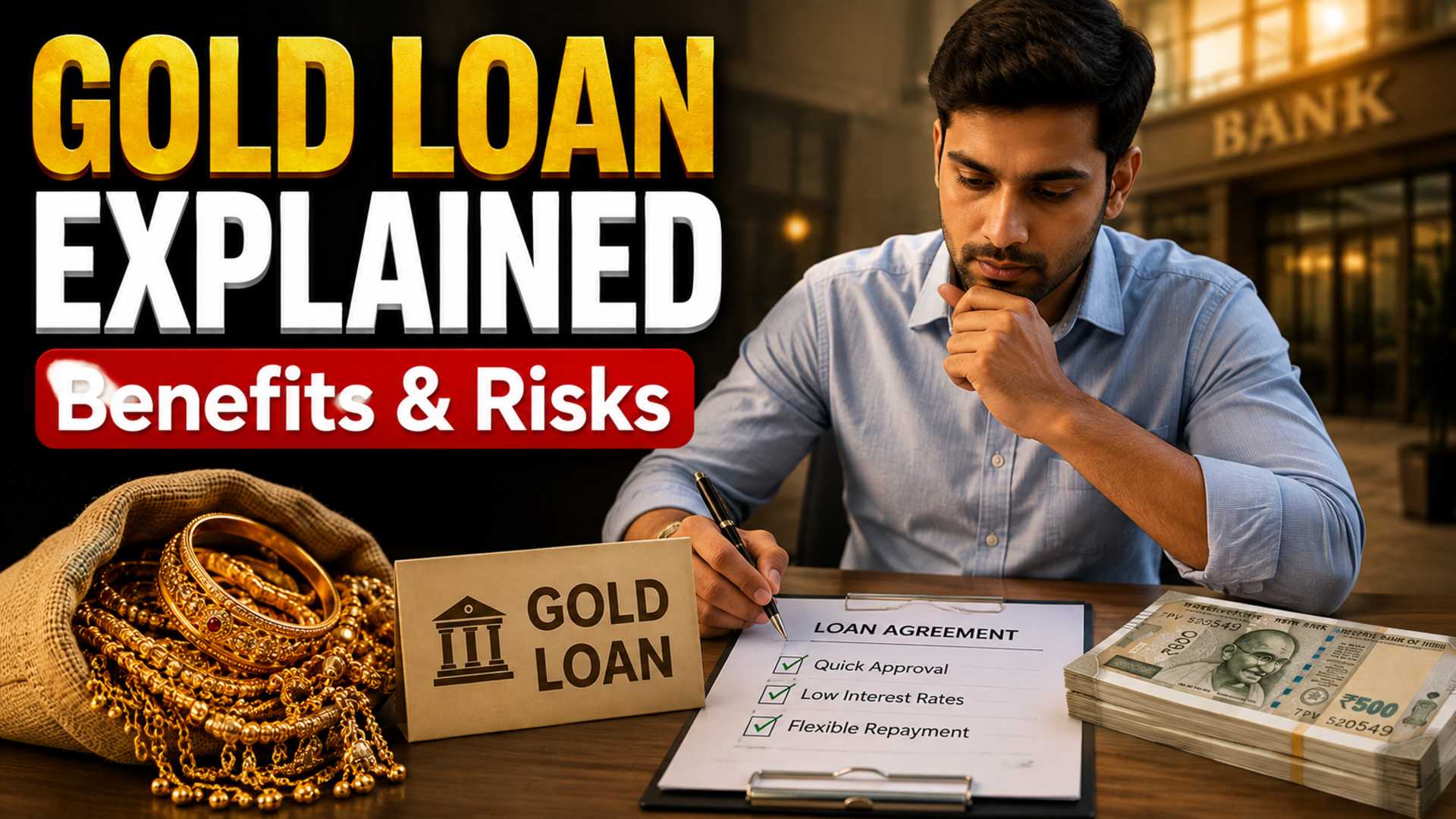
In a gold loan, the eligible gold jewellery, ornaments or certain gold coins are offered to a financial institution or a lender as security in return for cash amount. This kind of borrowing is quite different from selling gold, as the borrower will remain the owner of the item until the terms of the agreement are fulfilled. Gold loans in India are a popular way to access quick funds by pledging eligible gold jewellery, ornaments or certain gold coins as collateral with a lender.
Such a gold loan scheme enjoys high popularity in India because it allows one to receive money quickly with fewer documents compared to many other loan schemes. But there is a downside of taking such a loan: if one fails to pay it off and settle the default situation, his or her gold will be auctioned. Regulated lenders have been directed by the Reserve Bank of India to introduce a harmonized framework for gold/silver loans until April 1, 2026.
What Is a Gold Loan?
A gold loan, or loan against gold, is a secured loan. The customer places as security eligible gold jewellery, ornaments, or gold coins, and the bank gives a loan in accordance with the value of eligible gold. It should be noted that the bank normally does not assess the value of gold jewellery only at the retail price.
Under the RBI framework, valuation is based on the intrinsic value of the gold content, taking its purity into account. Precious stones and other non-gold components are not included in the collateral value.
This is important since the value of an item of jewellery consisting of diamonds, gemstones, making charges, or other materials could be quite high compared to the gold loan value.
How Do Gold Loans Work in India?
The procedure is not too complicated. Firstly, you send the gold jewellery or any other eligible asset to the lender. The lender analyses the purity, gross weight, and net weight of the gold asset. There will be deductions made for the stones, alloy, fastenings, and other non-gold parts as well.
Then the lender calculates the loan amount based on valuation and LTV ratio applicable. The gold is kept as collateral by the lender while the loan amount is paid after completing all the necessary documentation and KYC process.
The RBI guidelines mandate that the lender gives the borrower a certified assay sheet having all the details of purity, gross weight, net weight, deduction, and value ascertained at the sanction time. The borrower should receive a copy.
Repayment depends on the product. Some gold loans use EMIs, while others may use bullet repayment, where principal and interest are paid at maturity. Gold-loan overdraft products are another option offered by some lenders. For example, SBI currently offers EMI, bullet-repayment and overdraft variants.
Once the loan and applicable dues are fully settled, the lender must release the pledged collateral on the same day where possible and, under the RBI directions, no later than seven working days.
How Much Can You Borrow Against Gold?
The amount depends mainly on the purity and net weight of the eligible gold, its valuation and the lender’s applicable LTV policy.
For consumption loans, the RBI’s current maximum LTV limits are:
| Total consumption loan | Maximum LTV |
| Up to ₹2.5 lakh | 85% |
| Above ₹2.5 lakh to ₹5 lakh | 80% |
| Above ₹5 lakh | 75% |
These limits have to be maintained throughout the loan tenure.
For example, if the lender values eligible gold at ₹2 lakh and the applicable maximum LTV is 85%, the regulatory ceiling would be ₹1.70 lakh. This does not mean every lender must offer exactly ₹1.70 lakh; a lender can apply its own product terms and risk criteria.
Another important point is that the RBI requires detailed credit assessment, including repayment-capacity assessment, when the total loan amount against eligible collateral exceeds ₹2.5 lakh.
What Are the Benefits of Gold Loans?
Quick access to secured credit
Because the loan is backed by physical collateral, the process can be simpler than applying for some unsecured borrowing products. CIBIL notes that gold loans generally involve relatively quick processing because of their secured nature.
You do not have to sell your gold
The biggest attraction is that you can raise money without permanently selling your jewellery. Once the loan is completely repaid, the pledged gold is returned according to the lender’s process.
Flexible use of funds
Depending on the product and lender, gold loans can be used for various personal or financial requirements. SBI, for example, describes its personal gold loan as a general-purpose product that can be used for expenses including medical emergencies and education-related requirements.
Credit requirements can be different from unsecured loans
Because the gold provides security, lenders may place substantial emphasis on the collateral rather than relying only on conventional unsecured-loan criteria. However, this does not mean credit history is irrelevant or that approval is guaranteed.
Potentially lower borrowing cost than some unsecured alternatives
In some cases, gold loans may have relatively cheaper interest rates than unsecured personal loans because the bank is able to secure the loan. However, a borrower must consider the cost rather than just the interest rate offered by comparing the costs incurred when processing and assessing the loan.
What Are the Risks of Gold Loans?
The biggest risk is losing the pledged gold
If you fail to repay your dues, the lender can ultimately initiate the auction process according to the loan agreement and applicable rules. CIBIL warns that continued non-payment can result in the lender auctioning the pledged gold to recover outstanding dues.
The RBI’s framework requires lenders to give adequate notice before initiating an auction and establishes transparency requirements for the auction process. The lender must also provide details of the auction outcome and refund any surplus, subject to the applicable rules. This makes repayment planning especially important when the jewellery has high financial or sentimental value.
Interest can make a short-term loan expensive
A gold loan can look affordable when you focus only on the amount received. The real cost depends on the interest rate, repayment structure, tenure and additional charges.
For illustration, a ₹1 lakh loan at a simple 10% annual interest rate would generate ₹10,000 of interest over one year before considering fees. Actual repayment can differ significantly depending on whether the loan uses EMI, bullet repayment, monthly interest servicing or another structure.
You may borrow more than you actually need
A higher eligible loan amount does not mean you should borrow the maximum available. Borrowing against an asset that you may struggle to replace can turn a temporary cash-flow problem into a serious financial problem.
Gold valuation may be lower than expected
Jewellery’s purchase price includes factors such as making charges and, in some cases, stones or other materials. These do not necessarily increase the value considered for the gold loan. RBI rules specifically require lenders to consider the intrinsic gold value rather than such additional costs.
Gold Loan vs Personal Loan: Which Is Better?
There is no universally better option. A gold loan may make more sense when you already own eligible gold, need funds relatively quickly and have a realistic repayment plan. A personal loan may be preferable if you do not want to pledge family jewellery or do not have sufficient eligible gold.
The correct comparison should include the interest rate, processing charges, repayment schedule, foreclosure conditions, total repayment amount and consequences of default.
The most important question is not simply “Which loan gives me more money?” It is “Which loan can I repay comfortably without putting an important asset at risk?”
What Should You Check Before Taking a Gold Loan?
Before signing the agreement, check the lender’s valuation of your gold, purity and net weight recorded in the assay certificate. Verify the interest rate and whether it is fixed or subject to change under the product terms.
Also examine the Key Fact Statement and loan agreement for processing, appraisal, documentation, auction and other charges. RBI directions require applicable charges to be clearly included in the loan agreement and Key Fact Statement.
Finally, understand exactly when the principal and interest are due. A bullet loan may have a lower-looking monthly burden because the principal is not paid through regular EMIs, but a large payment can become due at maturity.
Learn more : MSME Amendment Bill 2026
FAQs
Is a gold loan a secured loan?
Yes. This is because when applying for the gold loan, the borrower will use gold as collateral. The lender will keep the collateral till the loan is paid off in accordance with the agreement.
Can I get a gold loan without a high CIBIL score?
Possibly. Gold loans are secured by collateral, so lenders may place greater emphasis on the gold and the loan terms than they would for an unsecured loan. However, individual lenders can have their own eligibility and credit-assessment policies.
Can I use gold coins for a gold loan?
Eligible gold coins can be accepted subject to the lender’s policy and applicable RBI requirements. The RBI’s 2025 framework also places an aggregate limit of 50 grams on gold coins pledged by a borrower across such loans.
What happens if I do not repay a gold loan?
The lender can follow its default and auction procedure after giving the required notices. If the gold is eventually auctioned, the proceeds are used toward the outstanding dues according to the applicable terms and regulations.
How long does it take to get a gold loan?
The time varies by lender, branch and documentation. Some lenders advertise same-day sanction or disbursal. For example, SBI states that its personal gold loan is normally sanctioned on the same day and credited to the customer’s account.
Is gold loan interest always cheaper than a personal loan?
No. Gold loans can be cheaper than some unsecured borrowing because they are secured, but rates vary between lenders and products. Borrowers should compare the total borrowing cost rather than assuming a gold loan will always be cheaper.
When should I avoid taking a gold loan?
Do not consider it if you do not feel sure about the repayment, keep borrowing money to pay off your debts, or will suffer financially or emotionally in case the pledge jewelry is auctioned.
Final Takeaway
Gold loans in India can be a useful way to unlock liquidity from an existing gold asset without selling it. The process is generally straightforward, and the current RBI framework provides clearer rules around valuation, LTV limits, documentation, collateral handling and auctions.
But a gold loan should not be viewed as “easy money.” Fees and interest have to be paid even when the gold cannot be recovered in time. It would be best to only borrow what one needs and find out the overall costs of borrowing from regulated lenders, how repayment will take place and also ensure that one has planned the retrieval of their gold by the deadline.
Join us on Telegram Group.